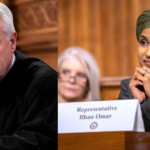
Ilhan Omar Once Said She Wasn’t Afraid of Deportation. Now Federal Investigators Are Looking Into Her Immigration History
Rep. Ilhan Omar (D-MN) once dismissed the possibility of being deported, saying she had no reason to fear losing her citizenship and could simply live somewhere else if it ever happened. Those comments are now getting renewed attention as federal investigators examine allegations involving her immigration history and family records.
And for a congresswoman who has repeatedly accused Republicans of using immigration enforcement to intimidate political opponents, the latest developments have put her own past under an uncomfortable spotlight.
The resurfaced remarks came from an interview last year with host Dean Obeidallah, who suggested Republicans were using imprisonment, deportation, and criminal investigations to silence political opponents.
“I worry that their go-to is to put their opponents in prison, criminalize us, stop dissent, deport people they don’t agree with politically,” Obeidallah told Omar.
The Minnesota Democrat agreed with his characterization, accusing Republicans of using those threats to intimidate and silence their critics.
“It is a tool to intimidate, to harass, to silence,” Omar claimed. She added that Republicans “would love to ultimately incarcerate and do all kinds of ungodly things to us.”
But when the conversation turned to whether she personally worried about being deported, Omar offered a rather different response.
“I have no worry. I don’t know how they take away my citizenship and, like, deport me — but I don’t even know why that’s such a scary threat? I’m not the 8-year-old who escaped war anymore. I’m grown. My kids are grown. Like, I can go live wherever I want,” she said.
Now those words are resurfacing as the congresswoman faces renewed scrutiny over allegations involving her family’s immigration paperwork.
Last month, Trump’s border czar Tom Homan raised the possibility that Omar could lose her naturalized citizenship and potentially face deportation if investigators establish that she committed fraud during the naturalization process. Homan’s comments brought additional attention to questions that have followed Omar for years.
Omar arrived in the United States as a refugee from Somalia in 1995 and became a naturalized American citizen in 2000. According to reports, federal investigators are now examining whether information provided by Omar or her late father, Nur Omar Mohamed, was misrepresented in immigration documents.
The investigation reportedly includes questions about her birth date and whether inaccurate information was used to obtain legal status and ultimately citizenship.
The inquiry has also reportedly examined whether her father omitted or misrepresented information about his military service in Somalia. These are serious questions, particularly because naturalization depends on accurate information being provided to federal authorities.
The investigation took another significant turn on October 12, when Homeland Security Investigations agents searched Omar’s Washington, D.C., residence. Agents reportedly seized phones, computers, notebooks, and other personal belongings as part of their investigation.
The search warrant reportedly identified potential offenses including conspiracy, immigration fraud, and making false statements. However, the allegations have not been proven, and an investigation does not automatically mean criminal charges will follow.
The scrutiny has also revived an older controversy involving Omar’s marriage history. For years, critics have alleged that she married Ahmed Nur Said Elmi, who they claim is her biological brother, to help him obtain immigration benefits.
Omar has repeatedly denied the allegation, but the controversy has continued to follow her political career.
During an October 21 interview with MS NOW host Chris Hayes, the congresswoman was once again questioned about her alleged relationship with Elmi. Omar dismissed the claims as “insane,” arguing that they originated from a Somali blog and were later amplified by right-wing conspiracy theorists.
Hayes did not let the subject go immediately. He pressed Omar on whether there was any truth behind the allegations, asking whether there was a “weird kernel of truth” to the story.
Her response was notable.
“Not to my knowledge,” Omar said.
That answer has attracted renewed attention because it came during a direct discussion about one of the longest-running controversies surrounding her personal history. Omar continues to deny the allegations, and they remain unproven.
The latest development came Tuesday, when a federal judge agreed to release redacted court records connected to the search of Omar’s home. However, the judge declined to unseal the 67-page affidavit that investigators submitted to support the search warrant.
Chief U.S. District Judge James Boasberg said making the affidavit public at this stage could expose witnesses and reveal sensitive investigative techniques. Prosecutors have been instructed to propose redactions by Friday, with some court records potentially becoming public as soon as Monday.
That means additional details could soon emerge, although the public will not necessarily see the full evidence investigators presented to obtain the warrant.
For Republicans and immigration-enforcement supporters, the investigation raises questions about whether the same immigration rules applied to ordinary Americans should also apply to elected officials. Naturalized citizens have legal protections, but citizenship obtained through proven material fraud can be subject to legal challenges under federal law.
Omar has spent years criticizing Republican immigration policies and accusing conservatives of using deportation threats for political purposes. Now, with federal investigators examining allegations involving her own immigration history, those previous remarks are receiving a fresh round of attention.
The investigation has not established that Omar committed a crime, and she should not be treated as guilty based on allegations alone. But the American public has every reason to expect transparency when serious questions arise involving the immigration records of a sitting member of Congress.
The coming release of redacted court records could provide more information about why investigators searched her residence and what evidence they are examining. Until then, the biggest questions surrounding Omar’s immigration history remain unresolved.