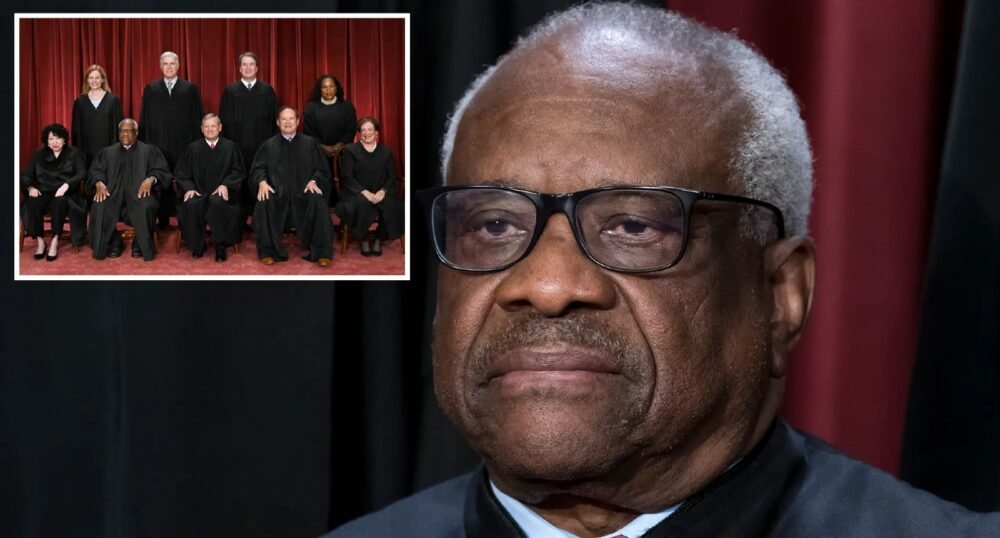
Justice Clarence Thomas wasn’t happy about a decision made by a majority of his Supreme Court colleagues regarding a case out of California.
The senior justice also issued a warning about what he sees happening in the future.
Thomas warned Monday that states could increasingly compel private citizens to deliver government-approved messages after the high court declined to hear a First Amendment challenge involving a California physician.
Thomas, joined by Justice Samuel Alito, dissented from the court’s decision not to take up the case, which centered on California requirements governing continuing medical education courses.
“When, as here, the government does not issue its own messages but instead requires private speakers to communicate the government’s viewpoint, the First Amendment applies,” Thomas wrote.
“A State cannot regulate its way out of First Amendment scrutiny. We should not permit the government-speech doctrine to be wielded as ‘a cover for censorship’ or a cloak for compelled speech,” he added.
The challenge was brought by Dr. Azadeh Khatibi, an ophthalmologist who argued that California was forcing her to make statements with which she disagreed while teaching courses required for physicians to maintain their licenses.
California law requires continuing medical education courses to include discussion of implicit bias in medical treatment.
The requirement applies to courses involving direct patient care and instructs educators to address issues including how unconscious attitudes can affect medical decisions.
Khatibi argued that the mandate violated the First Amendment by compelling her to communicate the state’s preferred viewpoint.
The Supreme Court declined her petition Monday without explaining its reasoning, as is customary when the justices reject requests to hear cases.
Thomas issued a dissent arguing the dispute raised important constitutional questions about the government’s ability to dictate what private speakers must say.
“The First Amendment generally prohibits the government from telling people what they must say,” Thomas wrote.
He warned that allowing governments to require private instructors to communicate government-selected ideas could extend well beyond medicine.
“If California can force a doctor to convey the State’s preferred message in a continuing medical education course, there is little reason why it could not force other professionals to do the same,” Thomas wrote.
Thomas argued that the constitutional problem becomes particularly serious when the government requires a private speaker to present contested ideas rather than simply disclose factual information.
The justice said states should not be permitted to avoid First Amendment scrutiny merely because compelled speech occurs in a professional or educational setting.
“Private citizens do not become government mouthpieces simply because they teach a state-mandated course,” Thomas wrote.
The state enacted the requirement as part of an effort to address alleged disparities in healthcare outcomes among different racial and demographic groups.
Supporters of the requirement argue implicit bias can influence medical treatment even when healthcare professionals do not consciously intend to treat patients differently.
Khatibi disputed California’s authority to force individual instructors to teach those concepts as part of their own courses.
Her attorneys argued that the state could provide its own implicit-bias training or require doctors to receive separate instruction without compelling private educators to personally deliver the message.
Lower courts rejected her challenge.
The Ninth Circuit Court of Appeals concluded that California could impose content requirements on continuing medical education because the courses serve a professional licensing function regulated by the state.
Khatibi then appealed to the Supreme Court.
The case raised questions about the line between government regulation of professional conduct and government-compelled speech.
The Supreme Court addressed a related issue in its 2018 decision in National Institute of Family and Life Advocates v. Becerra, when it struck down portions of a California law requiring pregnancy centers to provide certain government-mandated notices.
In that decision, the court rejected the idea that “professional speech” constitutes a separate category entitled to reduced First Amendment protection.
Thomas cited those principles in arguing that Khatibi’s challenge deserved Supreme Court review.